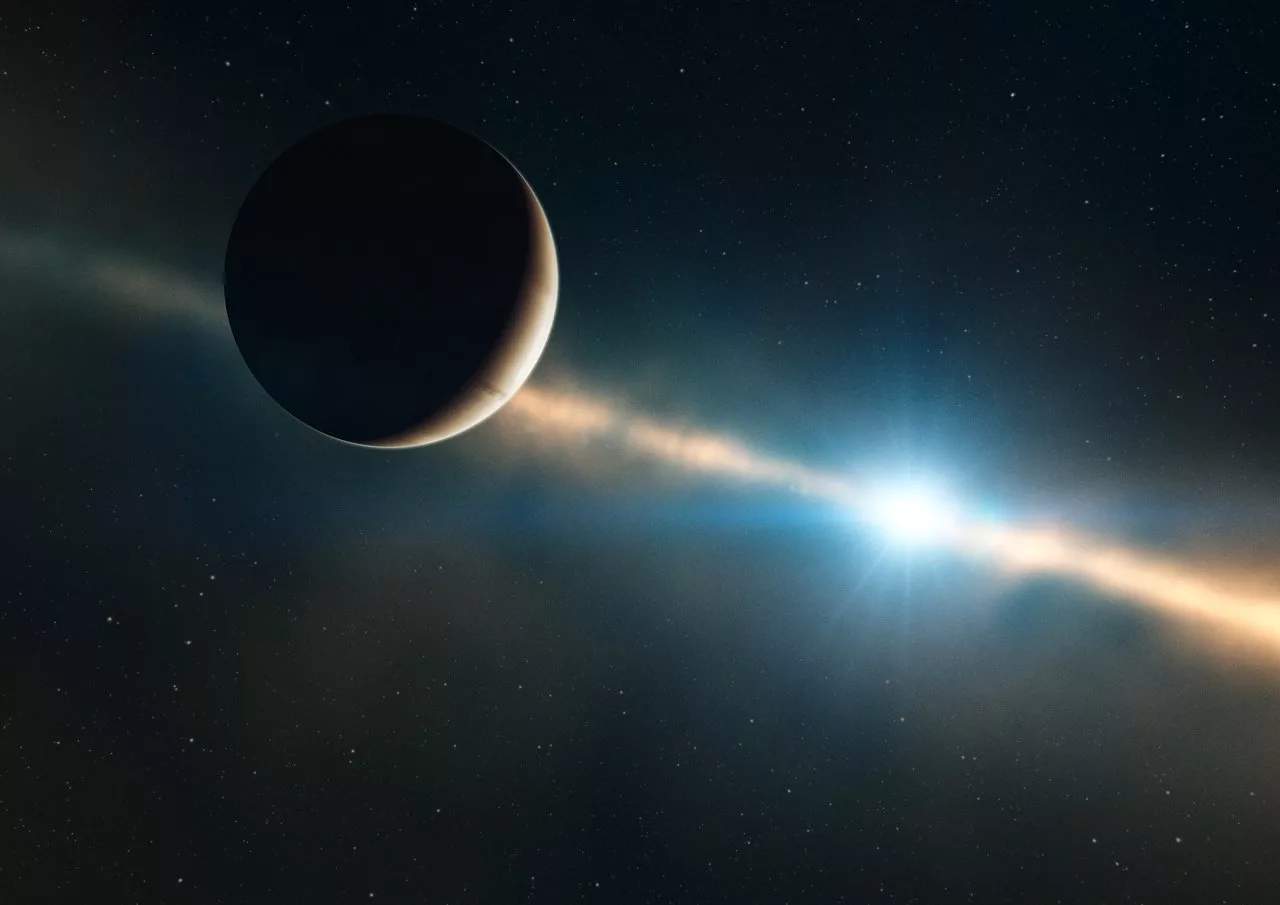
Astronomers have reported the first direct detection of radio emission from an exoplanet, identifying the source as Beta Pictoris b, a giant planet about 63 light-years from Earth. Using the MeerKAT radio telescope array in South Africa, researchers detected recurring, highly polarized radio bursts that they interpret as auroral emission generated by the planet’s magnetic environment.
The discovery is important because it provides the first direct measurement of an exoplanet’s magnetic-field strength, estimated by the researchers to be at least about 1.25 kilogauss. The research is currently available as a preprint, so the findings have not yet gone through the full peer-review process.
Introduction
Astronomers have reported a major new milestone in the study of planets beyond our Solar System: radio emission has been detected directly from an exoplanet for the first time.
The planet is Beta Pictoris b, a young gas giant located roughly 63 light-years from Earth in the constellation Pictor. Researchers used the MeerKAT radio telescope array in South Africa to observe radio emission that repeatedly originated from the planet rather than simply from the star it orbits.
The result, reported in a research preprint submitted in September 2026, could open a new way of studying the otherwise difficult-to-measure magnetic fields of distant planets.
Importantly, the radio signal is not evidence of an alien civilization or an artificial transmission. The researchers identify the emission as natural auroral radio radiation, produced through interactions involving charged particles and the planet’s magnetic field.
The finding is nevertheless significant because magnetic fields play an important role in how planets interact with their stars and surrounding space.
What Happened?
A team of researchers from the Center for Astrophysics | Harvard & Smithsonian and the University of Oregon reported the detection of radio emission from Beta Pictoris b.
Their study, titled “Discovery of radio emission from the exoplanet β Pictoris b,” was submitted to arXiv on September 15, 2026. The researchers used observations from the MeerKAT array, a major radio astronomy facility in South Africa.
The scientists detected both recurring bursts and persistent radio emission.
The bursts were described as:
- Rapid
- Recurring
- Highly circularly polarized
The observations covered frequencies between approximately 0.85 and 3.5 gigahertz.
The researchers concluded that the characteristics of the emission are consistent with a mechanism called the electron cyclotron maser instability.
This process can generate intense radio waves when energetic electrons interact with a magnetic field.
The frequency of this type of radiation provides information about the strength of the magnetic field where the emission originates.
That allowed the researchers to estimate a magnetic field of at least approximately 1.25 kilogauss for Beta Pictoris b.
Key Details
- Exoplanet: Beta Pictoris b
- Distance from Earth: About 63 light-years
- Type: Gas giant
- Host star: Beta Pictoris
- Constellation: Pictor
- Telescope: MeerKAT radio telescope array
- Location of telescope: South Africa
- Detected frequency range: About 0.85–3.5 GHz
- Emission type: Auroral radio emission
- Proposed mechanism: Electron cyclotron maser emission
- Estimated magnetic field: At least about 1.25 kilogauss
- Research status: Preprint; not yet fully peer reviewed
Why Beta Pictoris b Is Important
Beta Pictoris b is not a newly discovered planet.
Astronomers have studied the Beta Pictoris system for years.
NASA identifies Beta Pictoris b as a gas giant with a mass several times that of Jupiter. NASA’s current exoplanet catalog lists an orbital period of roughly 23.8 years and an orbital distance of about 10 astronomical units. Its discovery was announced in 2008.
The planet is also one of the best-known directly imaged exoplanets.
NASA describes the Beta Pictoris system as being approximately 63 light-years away and notes that Beta Pictoris b is around 10 times the mass of Jupiter in earlier descriptions.
The system itself is extremely young compared with our Solar System.
NASA has described Beta Pictoris as roughly 23 million years old, making it an unusually valuable laboratory for studying how young planetary systems develop.
The system also contains a large disk of dust and debris, providing astronomers with an opportunity to study interactions between young planets and material left over from planetary formation.
How Scientists Know the Signal Came From the Exoplanet
This is one of the most important aspects of the discovery.
Detecting radio emission from a star system is not necessarily the same thing as detecting radio emission from its planet.
A star can produce radio waves of its own. Therefore, when astronomers observe a radio signal from a system containing a planet, they have to determine where that signal originates.
Earlier studies had produced possible evidence of radio emission associated with exoplanet systems.
For example, astronomers using the LOFAR radio telescope reported in 2020 that radio emission from the Tau Boötes system could potentially be associated with its exoplanet. However, the researchers could not unambiguously establish that the signal originated from the planet itself rather than the host star.
That distinction is why the new Beta Pictoris b result is being described as a first.
The 2026 researchers say their observations allow the radio emission to be localized to the exoplanet itself, rather than simply to its surrounding stellar system.
What Are the Radio Signals?
Despite headlines describing them as “signals,” these emissions should not be confused with a radio message.
There is no evidence that Beta Pictoris b is transmitting information to Earth.
Instead, the researchers believe the radio waves are generated naturally by the planet’s magnetic environment.
The mechanism is associated with auroras.
On Earth, auroras such as the Northern Lights occur when energetic particles interact with Earth’s magnetic field and atmosphere.
Other planets in our Solar System also produce radio emissions associated with their magnetic environments.
Jupiter, for example, is a powerful natural radio source.
The new observation suggests that similar magnetic processes can be detected around a planet orbiting another star.
What Does the Magnetic Field Tell Scientists?
A planetary magnetic field is important because it describes how a planet interacts with charged particles and its surrounding space environment.
Magnetic fields can influence how stellar wind interacts with planetary atmospheres and can affect atmospheric escape.
The researchers behind the new study say planetary magnetic fields can also provide information about planetary interiors and the interaction between planets and their host stars.
For an exoplanet located dozens of light-years away, however, directly measuring a magnetic field is extraordinarily difficult.
Radio astronomy offers a potential solution.
Because the maximum frequency of electron-cyclotron-maser emission is related to magnetic-field strength, the radio observations can be used to estimate the field.
That is what makes the Beta Pictoris b observation particularly valuable.
A Magnetic Field More Than 1,000 Times Stronger Than Earth’s?
The reported minimum field strength of approximately 1.25 kilogauss is enormous compared with Earth’s roughly half-gauss surface magnetic field.
A direct numerical comparison should be made carefully because magnetic-field strength can vary with location and because the researchers’ value describes the field at the radio-emitting region rather than simply a single surface measurement comparable to Earth’s standard surface-field value.
Still, the measurement indicates a very strong magnetic environment.
The research team describes it as the first direct field-strength measurement for an exoplanet.
This gives astronomers a new observational window into the physical properties of planets outside the Solar System.
Background: How Exoplanets Were First Studied
An exoplanet is a planet that orbits a star outside our Solar System.
Astronomers discovered the first confirmed planets orbiting a Sun-like star in the 1990s. Since then, thousands of exoplanets have been identified using techniques such as:
- Transit observations
- Radial-velocity measurements
- Direct imaging
- Gravitational microlensing
- Astrometry
Most exoplanets cannot be photographed directly because their host stars are overwhelmingly brighter.
Instead, astronomers often detect planets indirectly.
For example, the transit method looks for the tiny dip in a star’s brightness that occurs when a planet passes in front of it.
Radial-velocity observations measure the small movement of a star caused by the gravitational pull of an orbiting planet.
Beta Pictoris b is unusual because it has been directly imaged.
Now, radio observations add another potential method for studying distant planetary systems.
Beta Pictoris b Has Been Studied for Years
The Beta Pictoris system has long been a major target for astronomers.
The star is surrounded by a prominent debris disk, and the system’s youth makes it especially useful for understanding planetary formation.
The European Southern Observatory reported the planet’s existence after observations with the Very Large Telescope helped confirm that the object was orbiting Beta Pictoris.
ESO has described Beta Pictoris b as a young giant planet located several astronomical units from its star.
Its relatively large size, youth and location make it an attractive target for studying planetary atmospheres and magnetic environments.
In 2014, ESO astronomers also measured the planet’s rotation rate and found that a day on Beta Pictoris b lasts only about eight hours.
That rapid rotation may be relevant to understanding the planet’s magnetic environment, although the new radio study focuses on the direct evidence from the detected emission rather than relying on rotation alone.
What Officials and Scientists Said
The most important source for the new claim is the research paper itself.
The authors—Kevin N. Ortiz Ceballos, Edo Berger and Yvette Cendes—report that their MeerKAT observations provide the first direct detection of auroral radio emission from an exoplanet.
Their interpretation is based on several properties of the observed emission, including its recurrence, polarization and frequency behavior.
The authors identify the radiation as electron cyclotron maser emission and use that interpretation to infer a magnetic field of at least approximately 1.25 kilogauss.
However, there is an important scientific qualification: the study is currently a preprint.
That means the research has been publicly released for the scientific community to examine, but it has not yet completed the formal peer-review process of a scientific journal.
Consequently, the results should be described as a reported discovery from a new research preprint rather than as a settled scientific conclusion.
Why This Matters
The importance of this discovery goes beyond simply detecting another type of radiation from a distant planet.
1. It provides a new way to study exoplanets
Most information about exoplanets comes from their effect on their stars or from their light.
Radio emission could provide an entirely different source of information.
2. Magnetic fields may become observable on more distant worlds
Magnetic fields are difficult to detect directly outside the Solar System.
If the technique can be confirmed and applied to additional planets, astronomers may eventually build a larger sample of exoplanets with measured magnetic properties.
3. It could improve our understanding of planetary atmospheres
A planet’s magnetic field interacts with charged particles from its star.
Studying that interaction could help scientists understand atmospheric loss and long-term planetary evolution.
4. It creates a new comparison with planets in our Solar System
Astronomers already study radio emissions from magnetized planets such as Jupiter.
Finding comparable processes around another planetary system gives researchers a way to compare planetary magnetic environments across very different systems.
Does This Mean Scientists Found Aliens?
No.
There is no evidence that the detected radio emission is an artificial transmission.
The researchers interpret the emission as a natural auroral process produced by the planet’s magnetic environment.
This distinction is important because the phrase “radio signal from an exoplanet” can easily be misunderstood.
Radio astronomy detects many natural signals from planets, stars, galaxies and other astronomical objects.
A radio signal is not automatically a communication signal.
In this case, the evidence points toward a physical process similar in broad terms to natural radio and auroral phenomena observed in our own Solar System.
How Far Away Is Beta Pictoris b?
Beta Pictoris b is approximately 63 light-years from Earth.
That means the radio emission detected by astronomers began its journey toward Earth roughly 63 years ago.
In practical terms, when astronomers observe the system today, they are seeing electromagnetic radiation that left the Beta Pictoris system decades ago.
NASA lists the Beta Pictoris system at approximately 63 light-years away.
The distance also demonstrates why the observation is technically challenging.
The radio emission from a planet is extremely faint compared with many astronomical radio sources, and separating the planet’s emission from its host star requires sensitive instruments and careful analysis.
What Happens Next?
The immediate next step is independent scientific scrutiny of the research.
Because the study is currently a preprint, other astronomers will have an opportunity to examine the observations, analysis and interpretation.
Future observations could also test whether the radio emission is persistent and whether its properties change as Beta Pictoris b moves through its orbit.
Additional radio observations may help refine the estimated magnetic-field strength.
Researchers may also attempt to apply similar techniques to other giant exoplanets.
If additional planets can be detected through their auroral radio emission, astronomers could eventually compare magnetic fields across different planetary systems.
That would help determine whether the strong magnetic field inferred for Beta Pictoris b is unusual or represents a broader characteristic of young giant planets.
A New Radio Window on Exoplanets
The discovery represents a potentially important expansion of exoplanet astronomy.
For decades, scientists have learned about distant planets by measuring changes in starlight, analyzing atmospheric spectra and, in a smaller number of cases, directly imaging the planets.
The new observation suggests that radio astronomy can provide another route.
Beta Pictoris b is particularly suitable for this kind of study because it is a young, massive planet in a relatively nearby stellar system.
The combination of a large planet, a young host star and a sensitive radio telescope created the conditions needed to detect its faint auroral emission.
If future observations confirm the finding, radio observations could become an important tool for investigating magnetic fields around planets beyond our Solar System.
For now, the most accurate description is straightforward: astronomers have reported the first direct radio detection from an exoplanet, Beta Pictoris b, and the observed emission appears to be natural auroral radiation associated with a powerful magnetic field.
FAQs
What exoplanet produced the first directly detected radio emission?
The exoplanet is Beta Pictoris b, a young gas giant orbiting the star Beta Pictoris about 63 light-years from Earth. Researchers detected its radio emission using the MeerKAT radio telescope array.
When was the exoplanet radio signal detected?
The discovery was reported in a research preprint submitted in September 2026. The study reports MeerKAT observations showing recurring radio bursts and persistent emission from Beta Pictoris b.
Is the radio signal from Beta Pictoris b evidence of aliens?
No. The researchers interpret the radio emission as a natural auroral phenomenon, not an artificial communication signal. There is currently no evidence that an extraterrestrial civilization produced the emission.
What causes the radio emission from Beta Pictoris b?
The researchers identify the emission as electron cyclotron maser radiation, a process associated with energetic electrons and magnetic fields. The observed radio waves are interpreted as auroral emission from the planet’s magnetic environment.
How strong is Beta Pictoris b’s magnetic field?
The researchers infer a magnetic field of at least approximately 1.25 kilogauss at the relevant emission region. They describe this as the first direct magnetic-field-strength measurement for an exoplanet.
How far is Beta Pictoris b from Earth?
Beta Pictoris b is approximately 63 light-years away. NASA lists the Beta Pictoris system at that distance.
Why are radio signals from exoplanets difficult to detect?
Exoplanets are extremely faint radio sources compared with many astronomical objects, and their host stars can also produce radio emission. Scientists therefore need sensitive instruments and observations capable of determining whether a detected signal is actually coming from the planet. The new study’s significance is that its authors report the emission can be directly localized to Beta Pictoris b.
Has radio emission from an exoplanet been suspected before?
Yes. In 2020, an international team reported possible radio emission associated with the Tau Boötes system. However, the researchers could not unambiguously establish that the emission originated from the exoplanet rather than its host star. The new Beta Pictoris b result is presented as the first direct localization of auroral radio emission to an exoplanet.
Is this discovery peer reviewed?
Not yet. The research was posted as a preprint in September 2026. The findings therefore remain subject to formal peer review and further scrutiny by the scientific community.

